
How Can AI Help My Business?
Cyber Security
 Frazer Lloyd-Davies
For many people, artificial intelligence still seems like a futuristic idea, more at home in a sci-fi film than the workplace. But this technology is now part of everyday life, embedded in the tools your business likely uses already. It’s filtering spam from your inbox, scanning your networks for suspicious activity and even recommending the next best product to a customer.
What’s changed in recent years is how accessible AI has become. You no longer need to be a large corporation with a team of data scientists and deep pockets. Advances in computing power, wider access to data and smarter algorithms have made AI far more usable – and it’s even built into off-the-shelf software. In fact, you’d be hard-pressed to find a vendor that isn’t incorporating AI into their products in some way.
With more than 15% of small businesses in the UK already using some form of AI, that number is only expected to grow. So the question isn’t really “Can we use AI?” It’s “How should we be using it?”
What is AI?
Artificial intelligence refers to the use of computers to perform tasks that usually require human intelligence. This might involve recognising patterns, understanding speech or text, making predictions based on historical data or generating new content. AI doesn’t “think” in the way people do, but it can be trained to automate these processes much faster and more accurately than a person ever could.
Some of the most common forms of AI include:
- Machine learning (ML): Algorithms that are trained on large sets of data so they can learn from it and make predictions or decisions without being explicitly programmed for every scenario.
- Natural language processing (NLP): The ability for computers to understand, interpret and respond to human language – spoken or written.
- Generative AI: AI that can create new content such as text, images, music or code based on patterns it has learned from existing data.
- Computer vision: The use of AI to process and interpret visual information. This includes identifying objects in photos, detecting movement in security footage or reading signs in self-driving cars.
Applications of AI in Business
AI can be applied to almost every part of a business. Below are some examples of how different departments are already using it to improve their bottom line.
Customer Support
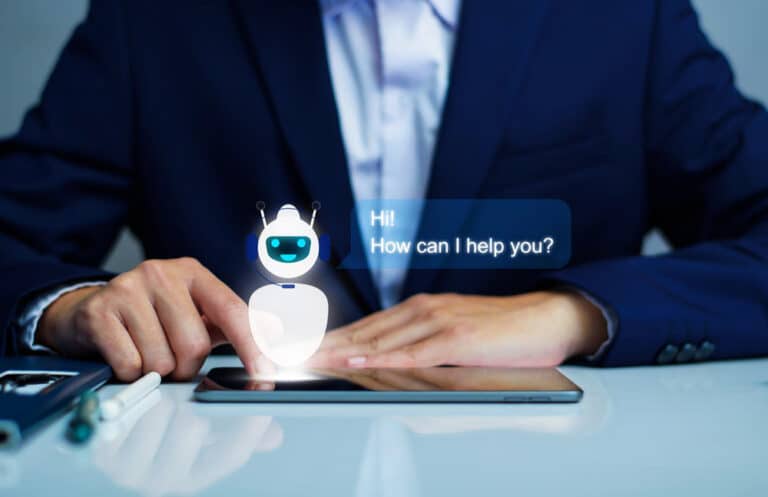
Chatbots and virtual assistants are increasingly being used by support teams to handle a high volume of customer enquiries without the need to increase headcount. Unlike basic bots that are pre-programmed with set answers and decision trees, AI-powered chatbots use natural language processing and machine learning to understand what a customer is asking, even if the phrasing isn’t quite what the system was expecting.
This helps conversations feel more natural and less frustrating for the user. The chatbot can answer frequently asked questions, assist with order tracking, check stock levels or explain a return policy without requiring human input. And if something falls outside its remit, the bot can hand it over to the right person or department. Over time, these systems can learn from past interactions to improve the accuracy and relevance of its responses.
HR and Recruitment
AI can assist human resources departments with many of the time-consuming tasks that come with hiring and supporting staff. Rather than manually sorting through applications, AI algorithms can identify specific keywords in job descriptions that match candidates’ qualifications or relevant skills. It can then automatically shortlist candidates based on how closely their profiles match the desired criteria.
AI is also being used to support staff once they’re in the business. It can analyse information from feedback forms or performance reviews to highlight patterns in engagement, satisfaction or potential issues. For example, if the data suggests that a particular team is experiencing higher stress levels or lower productivity, HR can step in sooner with the appropriate level of support.
Marketing
Marketing departments are using AI to analyse large sets of behavioural data – like page views, how far users scroll, how long they stay on a page and what links they click – to better understand how people interact with their content. One of the most common uses is audience segmentation. AI tools can group customers based on shared traits, such as purchase history, browning habits or demographics. This gives marketers the ability to tailor campaigns to each group. For example, frequent buyers might receive loyalty offers, while new customers get a welcome discount. These segments update automatically as customer behaviour changes over time.
Predictive analytics is another growing application. By learning from previous campaigns, AI can help forecast which messages or channels are likely to perform best with a particular audience. Some tools even suggest the best time to send an email or which customers are most likely to respond, helping teams make smarter, data-led decisions.
Supply Chain Management and Logistics
AI is helping businesses improve how they manage stock and plan for future demand. By using machine learning, it can analyse historical sales data, seasonal trends and external factors like weather or local events to forecast demand more accurately. This reduces the likelihood of running out of popular products or over-ordering items that might not sell. AI can also monitor stock levels and trigger reorders automatically once they reach a certain threshold.
Once a product is ready to ship, AI can support the process of getting it from A to B more efficiently. It processes live data, factoring in things like traffic, driver availability and fuel usage to suggest the best delivery route. In larger operations, it’s also being used in warehouses to automate physical tasks like picking and packing goods.
AI Cyber Security at Acronyms
As AI becomes more common in business, it’s only natural to have some concerns. Questions around privacy, data security and ethical use are all valid – especially when the technology is developing quickly and the guidance is still catching up. There’s also the worry that AI might replace jobs or take over processes that are better handled by people.
But AI isn’t here to take over. When it’s used responsibly, it can support your team by helping them do more with the time they’ve got. That’s exactly how we approach it at Acronyms.
We use leading platforms like SentinelOne and Huntress as part of our cyber security services. These AI-powered tools monitor behaviour across every aspect of your network to detect and respond to threats that often evade traditional antivirus software. Combined with the eyes and expertise of our technicians, we’re able to provide advanced protection against increasingly sophisticated cyber attacks in a way that works for your business.
If you’d like to know more about how we use AI in practice, or how it could support your operations, get in touch with our team today.